

Introduction
Welcome back to the weekly newsletter.
Let's talk about failure.
Failure hurts. Don’t need to pretend otherwise. A missed target, rejected application, failed project, broken plan, lost opportunity, or poor decision can hit hard. It can make you question your ability, your direction, and your future.
But some failures become turning points. Not because they feel good. They definitely don’t. They become turning points because you stop running from them and start extracting what they came to teach you. This week’s tool is the Failure Debrief: a practical way to turn each flop into knowledge, direction, and a better next move.
A Failure Debrief is not about forcing a positive mindset. It is not “everything happens for a reason” or “just stay optimistic.” It is more useful than that. It helps you take a painful result, separate emotion from evidence, find the lesson, and decide what changes now. A failure can become one of the most important moments in your life.
Weekly highlight: Turn each flop into a knowledge boost.
Success often confirms what you already believe. Failure interrupts you.
It shows where your plan was weak. It exposes a skill gap. It reveals a poor assumption. It shows where you were relying on hope instead of preparation. It may show that the goal was right, but the method was wrong. Or that the method was fine, but your consistency was not strong enough.
That is why failure can be so valuable. It gives sharper feedback than comfort.
But only if you review it properly.
If you ignore failure, you repeat it. If you overreact to failure, you make it your identity. If you debrief failure, you turn it into usable knowledge.
That is the goal.
Start with the event, not the emotion
After a failure, your mind wants to build a story quickly.
“I’m not good enough.”
“This always happens.”
“I’ll never fix this.”
“Other people are just better.”
“I wasted my time.”
That story may feel true in the moment, but it is not useful. Start with the event instead.
Write one clean sentence: “What actually happened?”
For example: “I missed the deadline by three days.”
Or: “The interview did not move to the next round.”
Or: “The project launched, but the result was below target.”
Or: “I stopped following the routine after one week.”
Keep it factual. No self-attack. Just the event.
This gives you a stable starting point.
Separate the pain from the lesson
Pain is real, but pain is not always precise.
You may feel embarrassed, angry, disappointed, or tired. That is normal. Let the emotion exist, but do not let it write the lesson for you.
A useful Failure Debrief asks: What is this failure showing me?
Maybe it shows that you need better preparation. Maybe it shows that your goal was too vague. Maybe it shows that you need stronger boundaries. Maybe it shows that your environment is working against you. Maybe it shows that you need help, feedback, or a different strategy.
The key is to look for the useful signal.
A failure is not automatically proof that you should stop. Sometimes it is proof that you need to upgrade how you operate.
Find the controllable cause
Do not blame everything on yourself. That is not accountability. That is punishment.
At the same time, do not blame everything outside yourself. That blocks growth.
Look for the part you can control or influence.
If you failed an interview, maybe the market was difficult. That may be true. But the controllable cause could be weak examples, unclear positioning, or not enough preparation for commercial questions.
If a project failed, maybe stakeholders changed direction. Or maybe the controllable cause could be poor risk escalation, unclear ownership, or not enough alignment at the start.
If a health routine failed, maybe the week was stressful. But could it be that a plan was too ambitious, no fallback option, or poor timing?
The question is not “Who is guilty?”
The critical question is: What can I change next time?
Turn the failure into one upgrade
A debrief is only useful if it changes behavior.
Do not leave with ten lessons. That creates noise. Choose one upgrade.
One better rule. One stronger system. One skill to improve. One conversation to have. One assumption to test. One boundary to protect. One preparation step to add.
For example:
If the failure was a missed deadline, the upgrade could be a mid-point check-in before every deadline.
If the failure was a rejected application, the upgrade could be sharper role targeting and stronger achievement examples.
If the failure was poor consistency, the upgrade could be a smaller fallback version of the habit.
If the failure was a bad decision, the upgrade could be using a Fact vs. Story Split before acting under pressure.
The failure becomes valuable when it produces a better operating rule.
Look for the bigger turning point
Some failures are small. Others are life signals.
They show that your current path is not working. That your health cannot keep taking the hit. That your career needs a different direction. That your relationships need more attention. That your standards have slipped. That you have been living on autopilot for too long.
These moments are uncomfortable, but they can be powerful.
Many people only change after the old way stops working. The failure becomes the interruption that finally wakes them up.
That does not mean you should be grateful for every painful event immediately. Some things simply hurt. But when you are ready, ask: What is this failure asking me to change?
That question can turn a bad chapter into the start of a better one.
Close the debrief with the next move
Do not end the process in reflection. End it in action.
Write one sentence: “Because of this, I will now ____.”
Keep it specific.
“Because of this, I will prepare three stronger examples before the next interview.”
“Because of this, I will send risks earlier instead of waiting until they become urgent.”
“Because of this, I will reduce the workout plan to something I can repeat.”
“Because of this, I will stop saying yes to work I cannot deliver properly.”
That sentence matters. It converts failure into direction.
Without the next move, the debrief stays theoretical. With the next move, the failure starts paying you back.
Application
Next time you fail run a 10-minute Failure Debrief:
- What actually happened?
- What did I feel?
- What is the useful lesson?
- What part was within my control or influence?
- What one upgrade will I make?
- What is my next move?
End with one sentence: “Because of this, I will now ____.”
Summary
Failure can hurt and still help. It can expose the weak point, force a better decision, and become the moment that turns your life around. Do not waste the flop. Debrief it, extract the lesson, choose one upgrade, and move forward stronger.
Till Next Time,
Maciej
Build the Life You Were Meant to Live

👉 Are you ready to start?
Begin with Establish Foundations. A free training to help you reclaim your time, energy, and focus, so you can finally start making meaningful progress.
👉 Want to truly change your life and achieve any goal?
Build Life Strategy that’s flexible, achievable, and aligned with what truly matters to you. In just 30 days, you’ll start making real progress toward your goals with tools built to fit your real life.
Take Control of Your Career
Complete blueprint to accelerate your career, salary and change forever the way you look at your career.
👉 Want to learn full framework?
Start with Career Framework. This free training and toolkit help you understand how your career really works, so you can stop guessing, start strategizing, and build a career that actually moves forward.
👉 Ready to re-design your career around your true value?
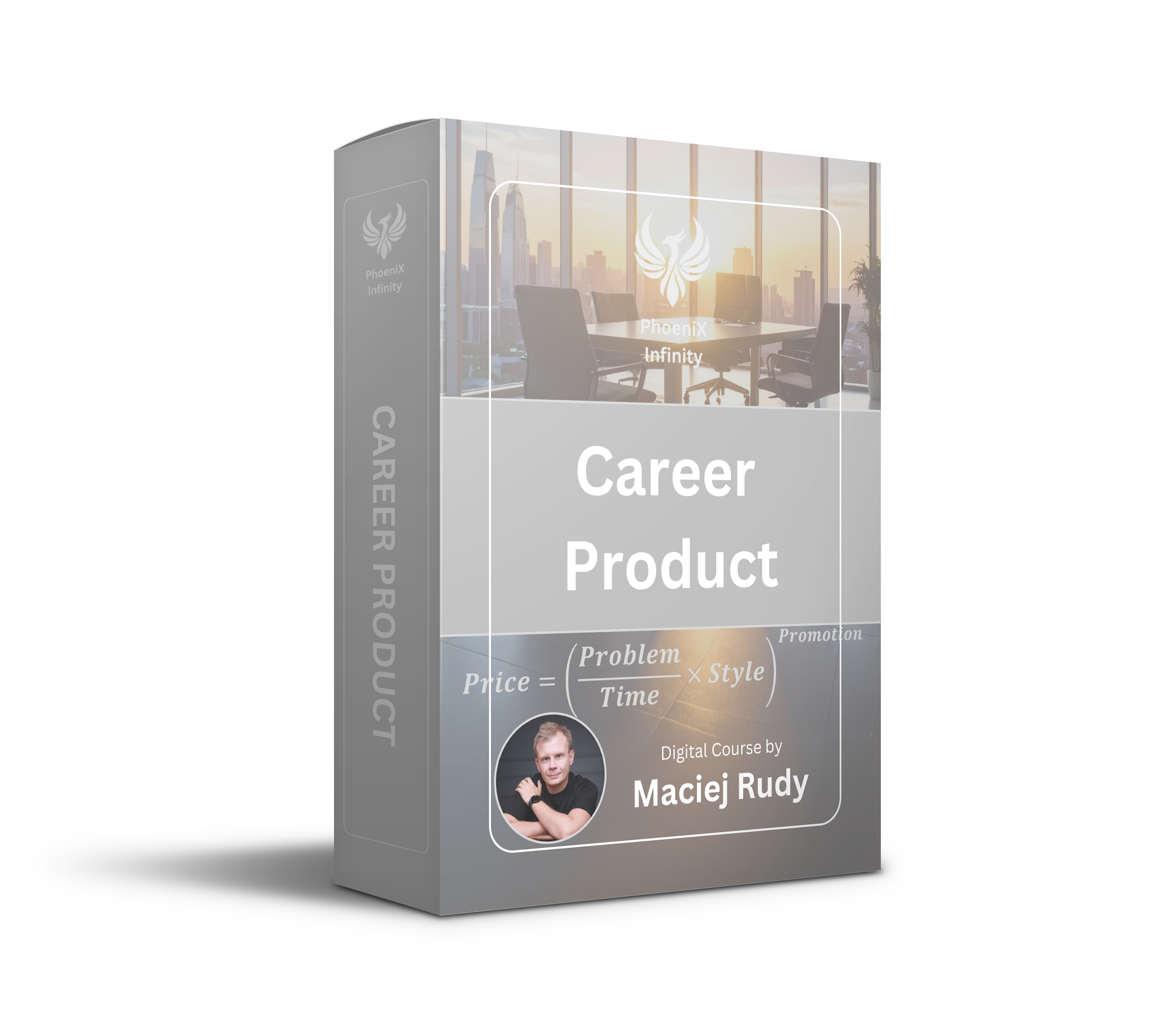
Step into Career as Product Course. If you're feeling stuck in your role, unsure how to communicate your value, or wondering why others with less experience are advancing faster, this course is for you.
No pressure. Just the tools, structure, and mindset to move forward, wherever you're starting from.




Responses