

Introduction
Welcome back to the weekly newsletter.
Most bad decisions aren’t made with bad intent. They’re made with bad inputs. We mix facts with assumptions, then act like the story is true. That’s where we break trust, grow conflict, and reputation takes hits. This week is a simple integrity tool: Fact vs. Story Split.
Weekly highlight: Separate facts from assumptions before decisions; write both lines and act only on facts.
The rule is simple: separate what you know from what you assume before you decide. Write the facts. Write the story your brain is telling. Then act only on facts, while you test the story with questions. This prevents emotional decisions dressed up as logic.
Your brain hates uncertainty. It fills gaps fast. That is useful for survival, but dangerous for work and relationships. The “story” feels real, so you respond as if it’s proven. That’s how you send the wrong email, accuse the wrong person, or escalate too early. A Fact vs. Story Split slows the reflex and restores accuracy.
The two-line method
Any time you feel heat (confusion, anger, fear, impatience) pause and write two lines:
- Facts: what you can verify right now.
- Story: what you’re assuming, predicting, or interpreting.
That’s it. Two lines.
What counts as a fact
Facts are observable and provable:
- “The report was due Friday 5pm; it arrived Monday 9am.”
- “Your colleague asked for feature A in writing.”
- “The meeting invite has no agenda.”
- “We have 3 reports unfinished ahead of close deadline.”
No motives. No character judgments. No mind-reading.
What counts as a story
Stories are interpretations:
- “They don’t respect me.”
- “They’re trying to sabotage.”
- “They always do this.”
- “My manager thinks I’m useless.”
Stories might be true. But they are not proven yet.
Act only on facts (and test the story)
Once you write both lines, you do two things:
- Make a fact-based move: a clear next step you can justify with evidence.
- Convert the story into a question: test it quickly and calmly.
Example:
- Fact: “No agenda.”
- Story: “This meeting will be a waste.”
- Move: “Ask for agenda/decision.”
- Question: “What decision do we need to make on this call?”
Example:
- Fact: “No reply for 48 hours.”
- Story: “They’re ignoring me.”
- Move: “Send a clear follow-up with deadline.”
- Question: “Did you see my note, can you confirm by 3pm?”
Use it for tough conversations
This method makes difficult conversations fair. It stops you from attacking motives and keeps you focused on outcomes.
Bad opener (story): “You don’t care about deadlines.”
Good opener (facts): “The deadline was Friday; we received it Monday. What happened, and how do we prevent a repeat?”
That’s integrity: firm and clean.
Use it for self-talk too
It works on yourself too:
- Fact: “I didn’t finish the task.”
- Story: “I’m lazy and hopeless.”
- Action: “Name the blocker. Remove it. Restart.”
- Stories punish. Facts guide.
Common traps (avoid these)
- Smuggling story into facts: “They were disrespectful.” That’s a story. Use behavior: “They interrupted me twice.”
- Over-documenting: You don’t need a page. Two lines is enough.
- Avoiding action: Facts still require a move. The goal is clearer action, not endless analysis.
The payoff
You create less conflict. You stop sending heat. You ask better questions. People trust you because your decisions are evidence-based. That is real integrity: fair process, clean language, solid choices.
Application
-
For the next 7 days, use Fact vs. Story Split whenever you feel heat.
-
Write two lines. Then do two moves: fact-based action + story-testing question.
-
Use it once in a meeting: “Here are the facts, here’s the assumption, here’s what I propose.”
Summary
Integrity shows up in how you decide. Facts keep you fair. Stories create drama. Split them, act on facts, test assumptions, and your decisions become cleaner, calmer, and more trusted.
Till Next Time,
Maciej
Build the Life You Were Meant to Live
👉 Are you ready to start?
Begin with Establish Foundations. A free training to help you reclaim your time, energy, and focus, so you can finally start making meaningful progress.
👉 Want to truly change your life and achieve any goal?
Build Life Strategy that’s flexible, achievable, and aligned with what truly matters to you. In just 30 days, you’ll start making real progress toward your goals with tools built to fit your real life.
Take Control of Your Career
Complete blueprint to accelerate your career, salary and change forever the way you look at your career.
👉 Want to learn full framework?
Start with Career Framework. This free training and toolkit help you understand how your career really works, so you can stop guessing, start strategizing, and build a career that actually moves forward.
👉 Ready to re-design your career around your true value?
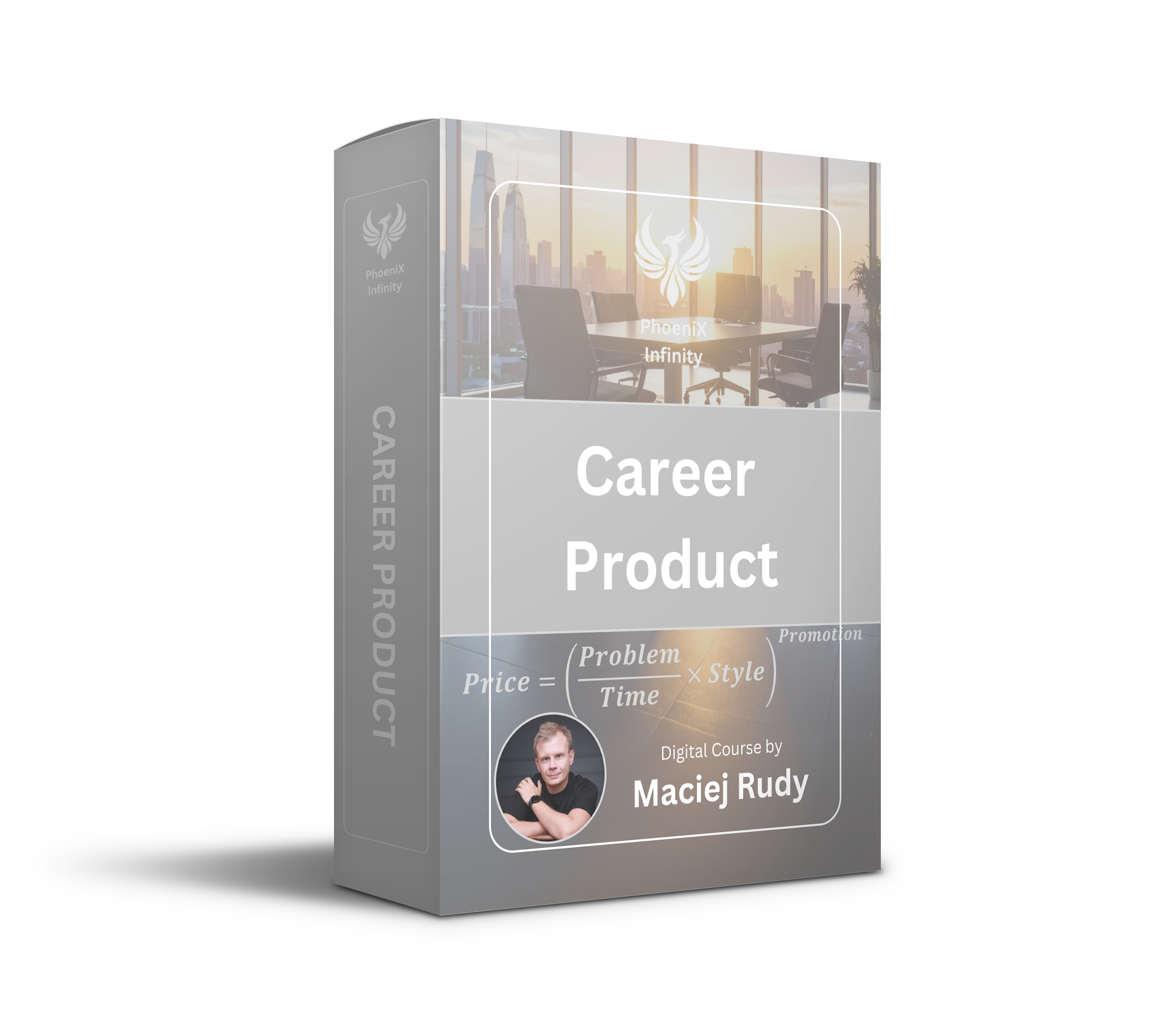
Step into Career as Product Course. If you're feeling stuck in your role, unsure how to communicate your value, or wondering why others with less experience are advancing faster, this course is for you.
No pressure. Just the tools, structure, and mindset to move forward, wherever you're starting from.



Responses