
The Best Tools for Long-Term Life Planning
Dec 04, 2025
Why We Drift Instead of Design Our Life
In the modern world it’s incredibly easy to lose yourself in the day-to-day. Emails, deadlines, late-night slides, constant messages from your boss or clients – all quietly become the center of your life. You tell yourself it’s “just a busy season,” that you’ll rest and reset next month, or next quarter, or next year.
Meanwhile, other parts of your life start to slowly deteriorate. Your health slips. You see friends less often. That passion project you once cared about now lives at the bottom of a to-do list you never open. And then one day, you hit a point where something inside you says:
“I can’t keep living like this.”
That moment is painful. But it’s also powerful. Because it’s the moment you move from surviving your life to designing it.
Change Needs Tools, Not Just Willpower
What's absolute positive is that change is absolutely possible. And you don’t need to blow up your entire life to start. But you do need structure. Not just another motivational quote or a Sunday-night “this week will be different” promise.
Long-term life planning requires:
- A way to see your life clearly
- A way to understand where your time, habits, and dreams are going
- A way to connect all the pieces into a strategy that actually fits you
That’s where a few simple, powerful tools come in. Used together, they can help you shift the direction of your life in months – and sometimes you’ll feel the first wins within weeks. Let’s walk through the best tools for long-term life planning, one by one.
Tool 1: The Wheel of Life. Your Starting Snapshot
You can’t design where you’re going until you’re honest about where you are.
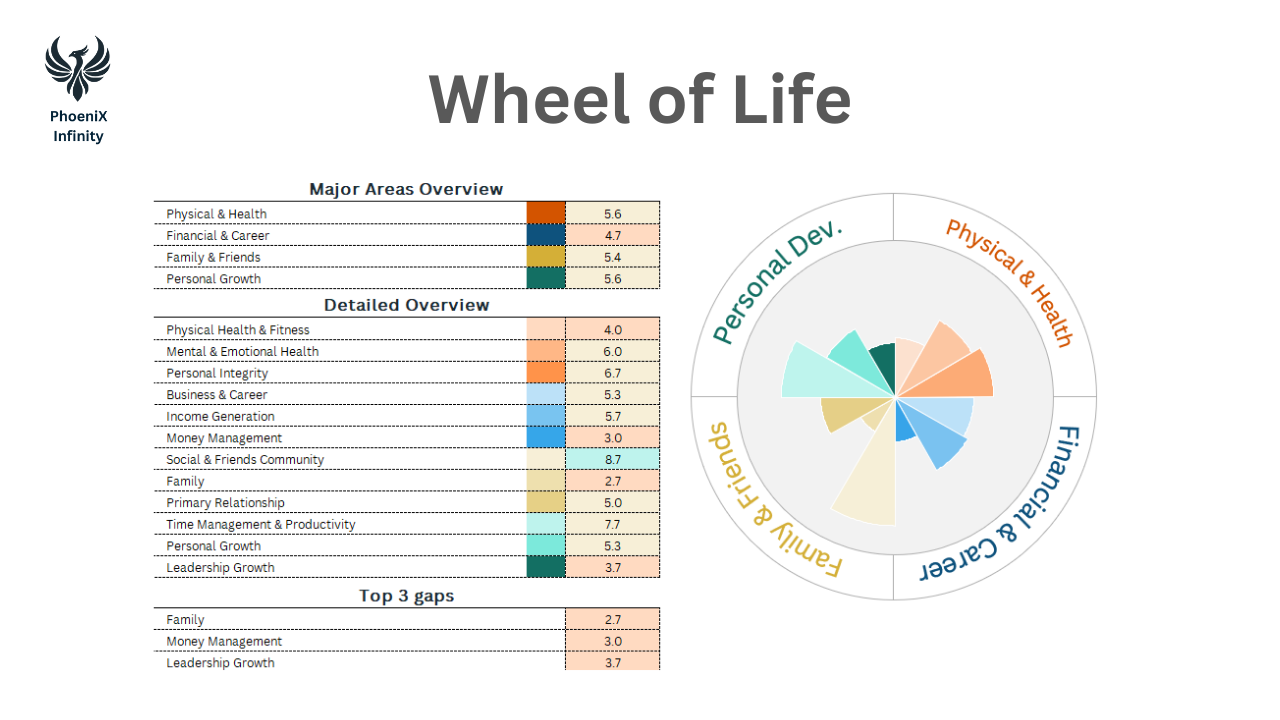
The Wheel of Life is a simple but powerful way to assess your life across key domains. There are many versions out there, but in The Phoenix Way®, we focus on four core areas to keep things practical and focused:
- Physical & Health
- Financial & Career
- Family & Friends
- Personal Growth
Imagine a circle divided into four segments. For each area, you give yourself a score from 1 to 10 based on how satisfied you feel today – not how you think you should feel, but how you actually do.
Physical & Health: Your Foundation
This is the base everything else rests on. Ask yourself: How is my energy? How do I feel in my body most days? How am I really doing mentally and emotionally?
This isn’t about having a six-pack or meditating at sunrise every day. It’s about whether your body and mind are supporting the life you want to live or quietly fighting against it. If you’re constantly exhausted, anxious, or running on caffeine and willpower alone, long-term life planning will always feel heavier than it needs to.
Financial & Career: Your Stability and Direction
Here, you’re looking at both money and meaning. Are you reasonably stable financially, or is money a constant source of stress? Do you feel your work is taking you somewhere you actually want to go, or are you climbing a ladder you’re not even sure you want to be on?
This area isn’t just “Do I earn enough?” but “Is the way I earn aligned with who I want to become long term?”
Family & Friends: Your Support System
Success without people to share it with feels strangely empty. Take a moment and ask: Do I have people I can be honest with? Do my relationships energise me or drain me? Am I present with the people I care about, or always half elsewhere in my head?
Long-term life planning that ignores relationships will eventually collapse under its own weight. You need support, connection, and shared moments – not just achievements.
Personal Growth: Your Development Momentum
This area is about the trajectory of your life. Are you growing? Are you learning? Are you becoming more of the person you want to be, or just repeating the same year over and over?
Personal growth includes your habits, your discipline, your time management, your learning, and your relationship with yourself. It is the engine that powers change in every other area.
Once you’ve scored each area, you’ll almost always see one or two that are dragging the wheel down. That’s your starting point.
Tool 2: Life Audits. Habits, Dreams, and Time
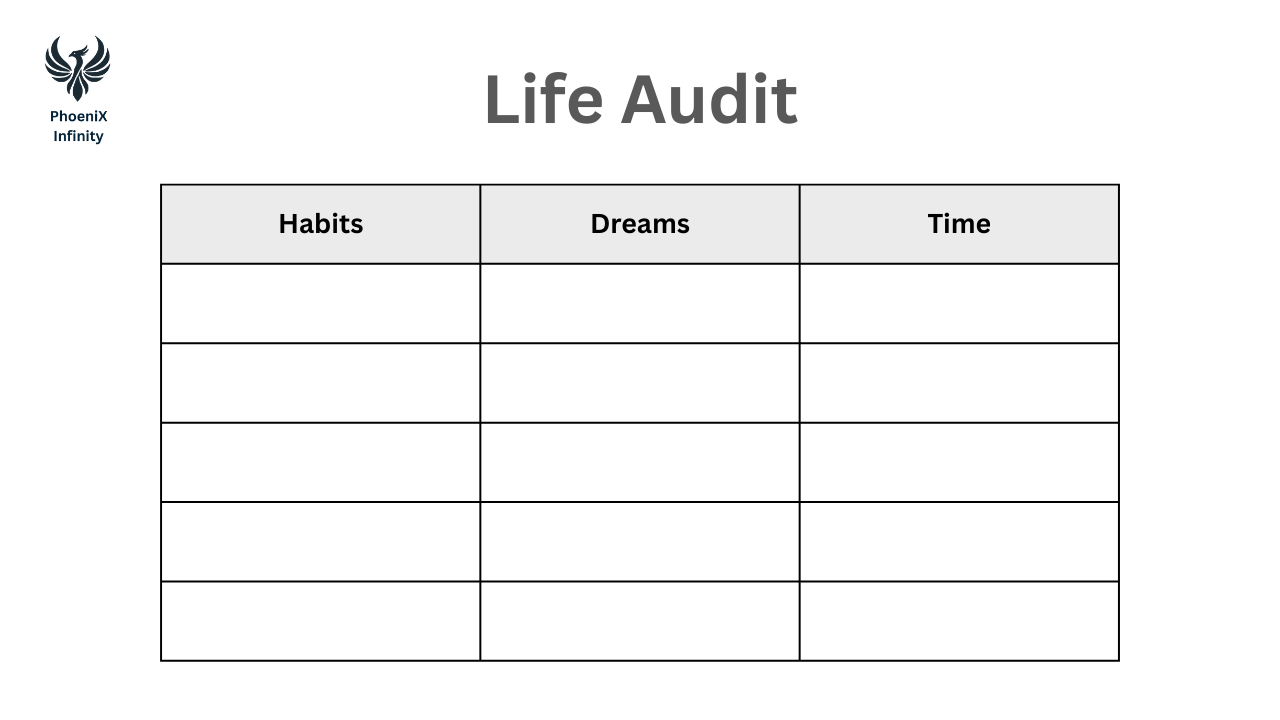
Once you’ve taken the snapshot, the next step is to zoom in. That’s where life audits come in. Short, structured reflections that reveal what’s really driving your current reality. In Phoenix, we use three simple audits: Habits, Dreams, and Time.
 Audit 1 – Habits: The Invisible Architecture of Your Life
Your habits quietly shape your future, whether you pay attention to them or not. Take a page and split it into three sections:
Current Positive Habits
Write down the things you already do that genuinely support your life; even if they’re small. Maybe you walk 15 minutes a day. Maybe you always check in with a close friend weekly. Maybe you plan your week on Sundays. These are your building blocks. Naming them gives you something to reinforce, not just “fix.”
Draining Habits
Now it gets uncomfortable. Ask yourself: What do I do regularly that drains my energy, time, or self-respect? It might be late-night scrolling, constant snacking when stressed, or saying yes to everything at work. Don’t judge yourself – observe. You’re mapping the system, not attacking yourself.
One New Anchor Habit
Finally, pick one small habit that would pull your life in a better direction if you repeated it most days. Not ten. One. Drink water first thing. Write three priorities each morning. Go for a 10-minute walk after lunch. Long-term life planning is built on simple actions repeated often, not grand initiatives done once.
Audit 2 – Dreams: Remember What You Actually Want
Before long-term planning can work, you need to reconnect with what you truly want – not what you’ve been told to want. Begin by briefly looking backward: As a kid or teenager, what did you dream of? What felt exciting, free, meaningful, before you learned what was “realistic”?
Then shift to now:
If you could remove the “how” and just focus on “what,” what would you want your life to include? Not just big dreams like “start a company,” but quieter ones like “have slow Sunday mornings with my family,” or “have the confidence to change careers.”
Once you’ve listed a few dreams, rate each on two scales:
- Importance: How deeply does this matter to you?
- Difficulty: How challenging would it be to move toward this, even a little?
High importance, low-to-medium difficulty dreams are often your best starting points. They are the quickest way to prove to yourself that change is possible.
Audit 3 – Time: Where Your Life Actually Goes
This is where things get brutally honest. For one week, track how you spend your time. Not perfectly, not obsessively – just enough to see the patterns. In 30–60 minute blocks, jot down what you were roughly doing: working, commuting, scrolling, watching, cooking, talking, exercising.
Then look at it through the lens of EDA:
- Eliminate: What could you stop doing with almost no downside? Pointless reports, recurring meetings that don’t matter, mindless scrolling.
- Delegate: What could someone else do 80% as well as you? At work or at home.
- Automate: What could be handled by a system or tool? Calendar reminders, bill payments, recurring tasks, report templates.
The point is not to erase all “non-productive” time. It’s to free enough capacity so long-term life planning actually has a place in your week, instead of being squeezed into the margins of an already overfilled day.
Tool 3: Life Strategy Maps® – See How Everything Connects
Once you know where you are (Wheel of Life) and what’s happening inside your life (Habits, Dreams, Time), it’s time to connect the dots. That’s where Life Strategy Maps® come in.
Take a blank page (or a simple digital canvas) and divide it into four stacked sections:
- Physical & Health
- Financial & Career
- Family & Friends
- Personal Growth
Now, in each section, write down:
- The key changes you want to make
- The initiatives, projects, or decisions that would move you in the right direction
For example:
- Under Physical & Health, you might have: “Sleep by 11pm on weekdays,” “Strength training 2x per week,” “Book annual health check-up.”
- Under Financial & Career: “Complete data analytics course,” “Talk to manager about next-step role,” “Build 3-month emergency fund.”
- Under Family & Friends: “Monthly dinner with close friends,” “Tech-free time with partner twice a week.”
- Under Personal Growth: “Start journalling 3 times per week,” “Read one book a month,” “Join a mastermind or community.”
Then draw arrows between items that influence each other. Maybe better sleep (Physical & Health) will directly impact your performance at work (Financial & Career). Maybe more personal growth (learning, reflection) will make you a more present partner or parent (Family & Friends). Suddenly your life stops looking like four separate buckets and starts to look like one integrated system.
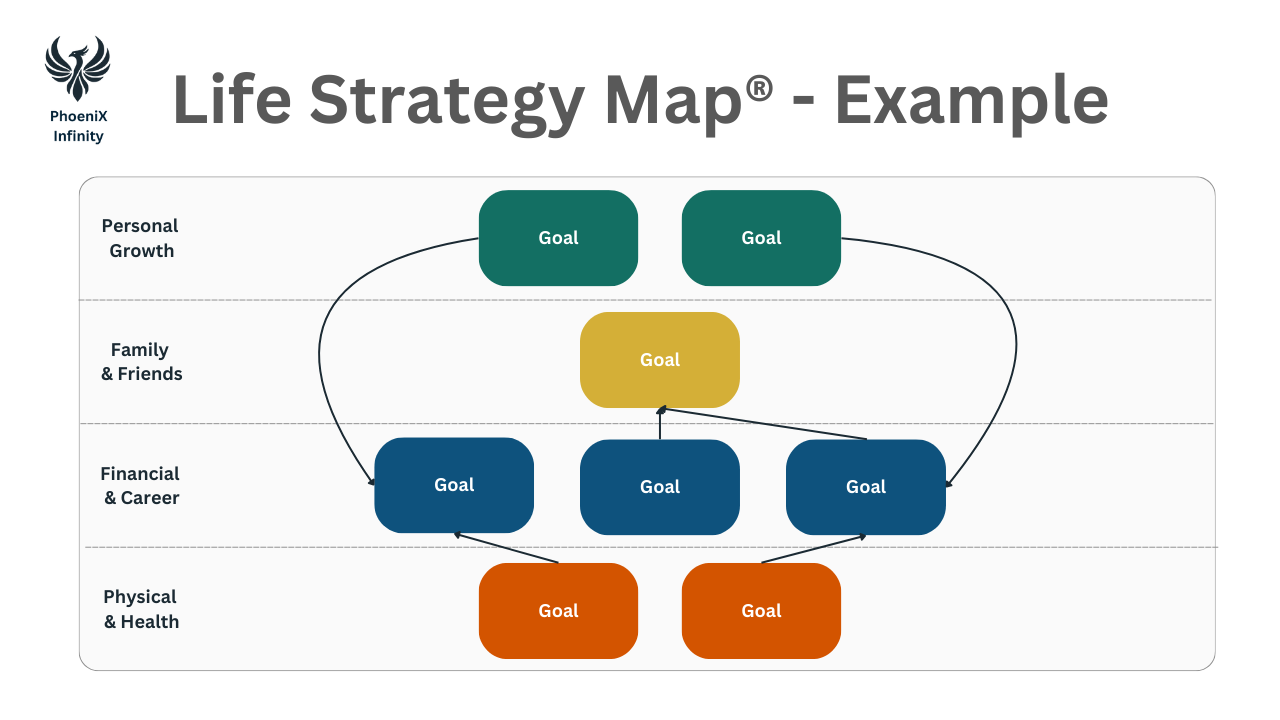
This is the moment where long-term life planning stops feeling abstract and starts feeling real. You can see your next steps on one page.
From Awareness to Strategy
Let’s zoom out. These tools aren’t meant to be used in isolation. They form a simple, repeatable flow:
- Wheel of Life: get a clear, honest picture of where you stand across your core life domains.
- Life Audits: understand what’s driving that picture: your habits, your forgotten dreams, and your use of time.
- Life Strategy Map®: translate your insights into concrete changes and see how they support each other.
From there, long-term life planning becomes a matter of sequencing and pacing:
- What is the one area that most urgently needs attention?
- Which 1–2 initiatives in that area could you realistically start in the next 30 days?
- How will you free the time and energy for them (using EDA and time audit insights)?
This is how you move from “my life needs to change” to “this week, I’m starting here.”

How to Start Today (Without Overwhelming Yourself)
You don’t need a full 10-year plan tonight. You just need to start the process.
Here’s a simple way to begin:
First, take 20–30 minutes and rough out your own Wheel of Life. Don’t overthink the scores. Go with your gut. Circle the one area that clearly feels most out of sync or most painful right now.
Next, pick one audit linked to that area.
- If your energy is collapsed, start with the Habits Audit.
- If your career feels meaningless, start with the Dreams Audit.
- If you say “I have no time,” start with the Time Audit.
From that audit, choose one habit to reinforce, one dream to honor in a tiny way, or one time drain to eliminate or reduce.
Then, when you have a bit more space, sketch your first Life Strategy Map®. It doesn’t need to be perfect. Think of it as version 0.1. Something you can iterate on every month.
Finally, commit to a simple reflection rhythm:
Once a week, spend 10–15 minutes asking:
- What did I actually do to move closer to the life I want?
- What got in the way?
- What is one small adjustment I can make next week?
Long-term life planning is less about dramatic changes and more about small course corrections, repeated consistently.
Your Life Won’t Change Until You Decide It Will
You can read every article, listen to every podcast, and save every “life planning” post but nothing changes until you make a decision.
A decision to stop drifting.
A decision to look honestly at where you are.
A decision to start using tools, not just hope, to design the next chapter of your life.
You already have everything you need to begin: awareness, curiosity, and the ability to take one small step. The tools I’ve shared are just there to help you organize that power and give it direction. Your future won’t appear by accident. It will be built, day by day, by the choices you make now.
So the real question is: What’s the choice you will make today?
Want a Step-by-Step System to Build Your Life Strategy?
If you don’t want to figure all of this out alone, that’s exactly what Build Your Life Strategy is for.
Inside, I walk you through the full process of long-term life planning:
- From life audit → clear 5-year vision → strategic priorities
- To quarterly initiatives → weekly rhythm → reflection loops
You also get the complete Phoenix Life Toolkit – Wheel of Life templates, audit sheets, Life Strategy Maps®, planning frameworks, review prompts you can reuse again and again and many many more.
You don’t need a perfect master plan to start.
You just need a real, practical framework and the tools to live it.
If you’re ready to design your life with intention, not impulse, This training will guide you step by step.
Stay connected with news and updates!
Join our mailing list to receive the latest news and updates from PhoeniX.
Don't worry, your information will not be shared.
PS - You will get a surprise bonus!
I hate SPAM. I will never sell your information, for any reason.